Collaborative vs Industrial Palletizing Robots: How to Choose
A carton packing line and a heavy-bag line can need very different palletizing cells. Start with what must be lifted, where it must be placed and how products arrive. Then compare robot platforms against that complete task.
SCR Robot · Based on the 2026 product catalog
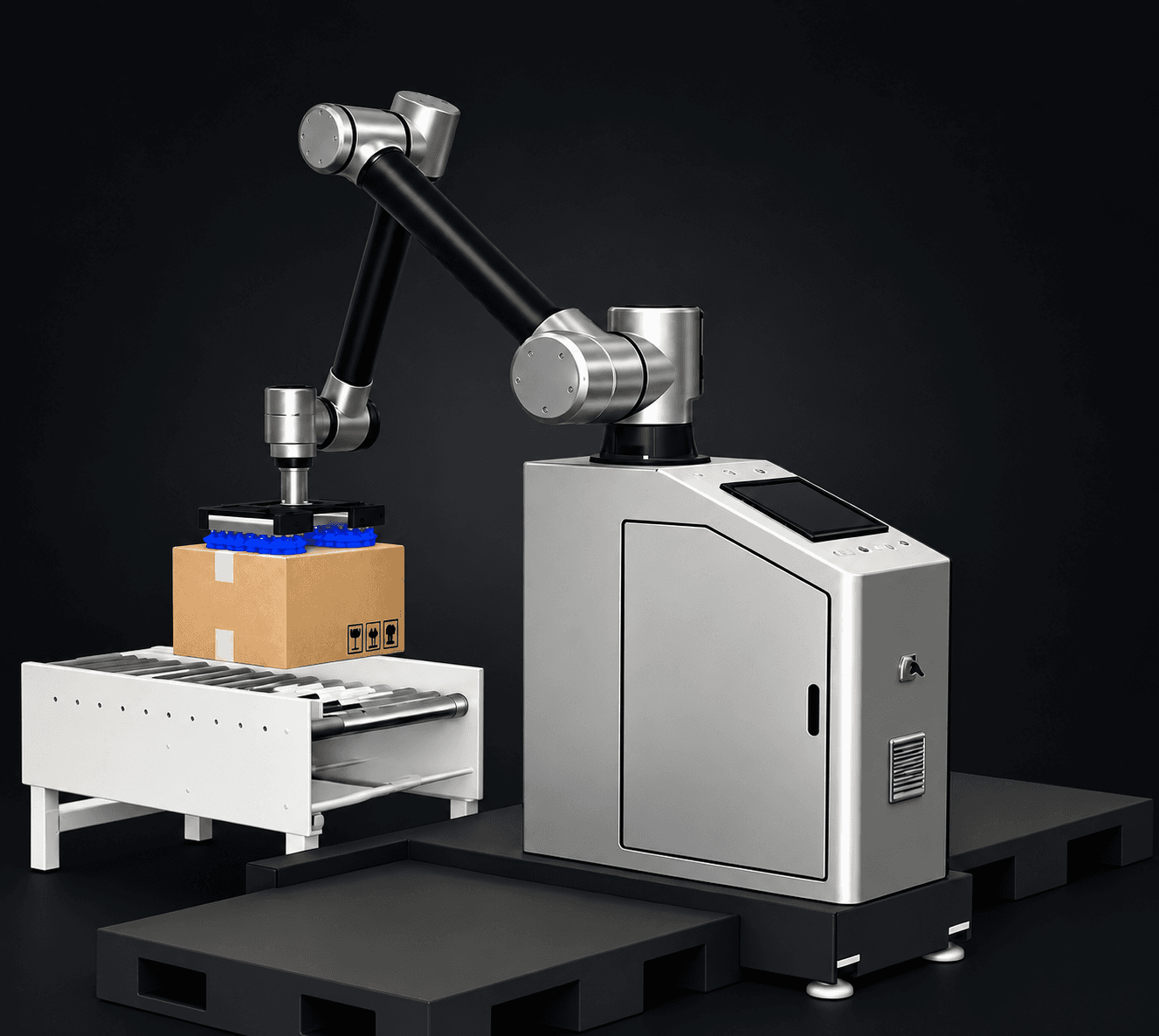
Shortlist a CR workstation for carton palletizing within its catalog envelope. Evaluate industrial platforms when the product, tooling, working area or line integration calls for a different cell design. Confirm the complete application before choosing a model.
| Decision | Collaborative workstation | Industrial palletizing cell |
|---|---|---|
| SCR starting points | CR30 / CR50, with fixed-base and lifting variants | ECR, SCH or SCR series, selected for the handling task |
| Product to review | Cartons, their dimensions, surfaces and pickup arrangement | Bags or cartons, grip method, load and arrival condition |
| Layout question | Can the infeed and all pallet positions fit the workstation envelope? | What robot position, conveyors and pallet handling are needed? |
| Output question | Can the verified path meet the required carton arrival rate? | Can the cell meet demand including pallet change and upstream stops? |
| Safeguarding | Assessed for the actual robot, tool, load and operator interaction | Assessed for the complete cell and its access points |
1. Start with the product and end-of-arm tooling
Record the heaviest and largest product, the packaging surface, how it deforms and whether one or several items must be picked together. A carton that holds its shape presents a different gripping problem from a soft filled bag.
The CR catalog includes 30 kg and 50 kg collaborative workstations. Industrial alternatives include compact ECR models and SCH palletizing robots across a broader payload range. These are catalog starting points; tooling mass, load position and the actual movement still need review. A nominal payload by itself does not confirm application suitability.
2. Check the full pallet pattern and stack height
Draw the conveyor pickup point, robot base and every pallet position. Check the far corners, bottom layer and top layer with the real tool and product dimensions. Robot reach is not the same measurement as finished stack height.
All four CR30/CR50 workstation variants list 1,900 mm reach. The L variants add a lifting arrangement with a standard 500 mm stroke. A lift changes the available working positions; it does not change the catalog arm-reach figure. Confirm the whole envelope rather than assuming that a lift solves every clearance issue.
3. Compare complete line output
Use the required products per hour together with the arrival pattern: evenly spaced cartons, short bursts and upstream stoppages lead to different buffering needs. Include pallet exchange, slip sheets where required, recipe changes and recovery after an interruption.
A catalog motion or packing-rate figure should not be treated as guaranteed output for a different product and layout. Ask for a cycle review covering your pickup, placement and pallet pattern before fixing the line specification.
4. Plan operator access and cell integration
Map where operators replenish pallets, remove completed loads and access equipment. Review guarding, interlocks and the robot/tool/load combination as part of the integrated cell. The word collaborative alone does not establish that an application can operate without guarding.
Compare proposals on the same scope: robot and base, gripper, conveyors, pallet positions, controls and operator access. This makes the difference between a workstation proposal and a complete line-integration proposal easier to assess.
- Product photos, packaging dimensions and weight range
- Target hourly output and product arrival pattern
- Pallet size, layer pattern and finished stack height
- Floor layout, infeed height and operator access
- Required tooling, pallet exchange and control interfaces
Related products and applications
30 kg vs 50 kg CR palletizers →
Compare the four CR configurations and understand the lifting variants.
CR50L lifting palletizing video →
See the lifting workstation, carton pickup tooling and pallet-area handling in operation.
CR collaborative palletizing workstations →
View catalog parameters, drawings and individual model pages.
Robotic bag palletizing →
Review bag presentation, gripping and end-of-line integration.
SCH industrial palletizing robots →
Review industrial robot options for palletizing and handling.
Match a workstation to your production line
Send product dimensions, weight range, target output, pallet details and a layout to discuss the model, tooling and integration scope for the actual task.